

Grass Fed, 'Nuff Said!
Sunday, April 14, 2013
Work day
Big work day at the farm: fixing drip hose, tilling the rest of the plot, mowing grass, planting potatoes, kale, lettuce, and broccoli. And writing very short blog posts!

Thursday, March 21, 2013
March Employee of the Month!

We are pleased to honor Yoshi. Yoshi is a two week old Rhode Island Red chicken. She joined the Iron Fish staff just a day or two after hatching and has really hit the ground running. When our chicks were introduced to worms, Yoshi took to it like a chicken to a junebug (almost literally) and while some of her flockmates were still staring at the squirming worms with weary suspicion, Yoshi knew just what to do.
Yoshi was named by our nephew Asher. The Yoshi of SuperMario (according to Wikipedia --I know, I am so hip) "has a long, sticky tongue that he uses to eat almost anything, even things much larger than himself" and can lay eggs! Yoshi plans to get into laying eggs in four or five months, but for now says she just wants to focus on "being a normal chick".
Upon hearing of this honor, Yoshi said, "I'm really just your average chicken. You could say I was at the right place at the right time. I saw the worm, he was wriggling, and I did what had to be done."
In recognition of this honor, Yoshi will be given a lifetime supply of chicken food and worms, and enjoy a premium roosting spot on the chicken log throughout the month of March.
Thursday, March 14, 2013
Garden Nemesis: The Squash Vine Borer
Here's a little water cooler gossip. You know who I don't like? Squash Vine Borers! SV Borers are actually moths that lay their larvae near squash plants. When the larvae hatch, they burrow into the center of the squash vine, where they will consume the plant from the inside. Since this destroys the plant's water and delivery structure, the plant will ultimately die.
If your once-prolific squash plant suddenly stops producing fruit, this could be an early sign of a squash vine borer infestation. Search the stems for a deposit that looks like little bits of sawdust leaking out of the plant. This is the borer's waste, which gets pushed out behind it as it makes its way through the plant.
Borers always seemed to hit my squash crops by August and while my methods to combat them extended the season a bit, I ultimately seemed to loose the battle. The methods of control I tried included covering the squash vines with foil so the borers can't get in. Perhaps this would have worked better if I'd been more aggressive about it....but squash plants grow quickly and besides, I always felt like that made my garden look like I was attempting to communicate with alien life forms via my garden gourds. I once tried using netting to keep the moths out. This meant I had to q-tip pollinate my squash, and they ultimately still got infected...most likely because they were planted near to a previous infestation and the larvae can hide out and over-season in the soil and come up when the soil warms.
The last line of defense is to do a little garden surgery at the infected area. Take a sharp knife to cut into the vine until you find the borer, and then extract it. Don't stop at just when you find one, as there are often multiple borers in one hole. You can add diatomaceous earth (DE), (an organic-approved pest control that consists of a type of naturally occurring sedimentary rock that dries out the insects that come into contact with it) to the infected spot in case you missed something. DE will affect good insects too like earthworms and bees, so I use it judiciously at the infection point and never near the flowers that will attract pollinators. You can then bury the cut area in well-composted soil and hopefully it will put out new roots in that section. If the vine is long I try to pre-emptively look for sections to bury so that my vine has multiple areas to pull water from. It will put out roots from any of its vine joints.
 |
| A squash vine borer that reaped havoc on my Ohio squash plants. I battled them every season. |
Borers always seemed to hit my squash crops by August and while my methods to combat them extended the season a bit, I ultimately seemed to loose the battle. The methods of control I tried included covering the squash vines with foil so the borers can't get in. Perhaps this would have worked better if I'd been more aggressive about it....but squash plants grow quickly and besides, I always felt like that made my garden look like I was attempting to communicate with alien life forms via my garden gourds. I once tried using netting to keep the moths out. This meant I had to q-tip pollinate my squash, and they ultimately still got infected...most likely because they were planted near to a previous infestation and the larvae can hide out and over-season in the soil and come up when the soil warms.
 |
| Wikipedia Image of the borer in moth form. |
 |
| Icicle Radish (Photo from gardening.about.com) |
One VERY exciting thing I learned about at the 2013 South Carolina Organic Growers Conference, which Ches and I attended last week, was that the Icicle Radish will repel squash vine borers. We got a pack of seeds and plan to put them around our squash. Their seasons for radishes and squash aren't the same, so most of these radishes will just sit as deterrent crops and be allowed to go to seed rather than being harvested.
Other Squash Vine Borer deterrent ideas are most welcome! I am hoping they just aren't as bad in North Carolina as they were in Ohio. Also, with significantly more land, we will finally be able to truly adopt a crop rotation system which should help alleviate perennial squash moth visitations.
Wednesday, March 13, 2013
Chicken Update
 We have chickens!!! The ability to house animals has been a something I've looked forward to and even thought about as a balancer to some of the sacrifices of rural life (e.g. no longer living across the street from a giant grocery store).
I had originally assumed we would order from one of the larger hatcheries, but as we did our research we learned that at many hatcheries the demand for hens so outweighs the demand for male chicks that males are often disposed of shortly after hatching. This did not match sync with our vision of being stewards of the land and animals, so we started looking into local options thinking that smaller scale operations were likely better equipped to handle this challenge.
 |
| The chicks traveled home in a small post office box. |
We learned that a neighbor just down the road from us hatches chicks, and had Rhode Island Reds and Buff Orpington's hatching this month. The chicks are be "straight run", meaning we'll get a mix of male and female chicks. We're not set up to house roosters, but our neighbor has offered to buy the roosters back from us after a few months when the sex becomes apparent.
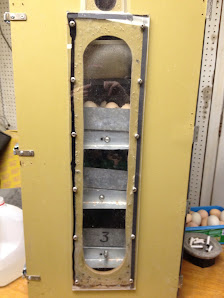 |
| The brooder the chicks came from. The hatchers said that they usually leave them in the brooder for about 12 hours after they hatch, until their feathers become soft and poofy |
 |
| Buying chicks looks like serious business in this photo. Definitely the photographer was not referring to the chickens as "chicki-doos" at this moment. |
Subscribe to:
Posts (Atom)